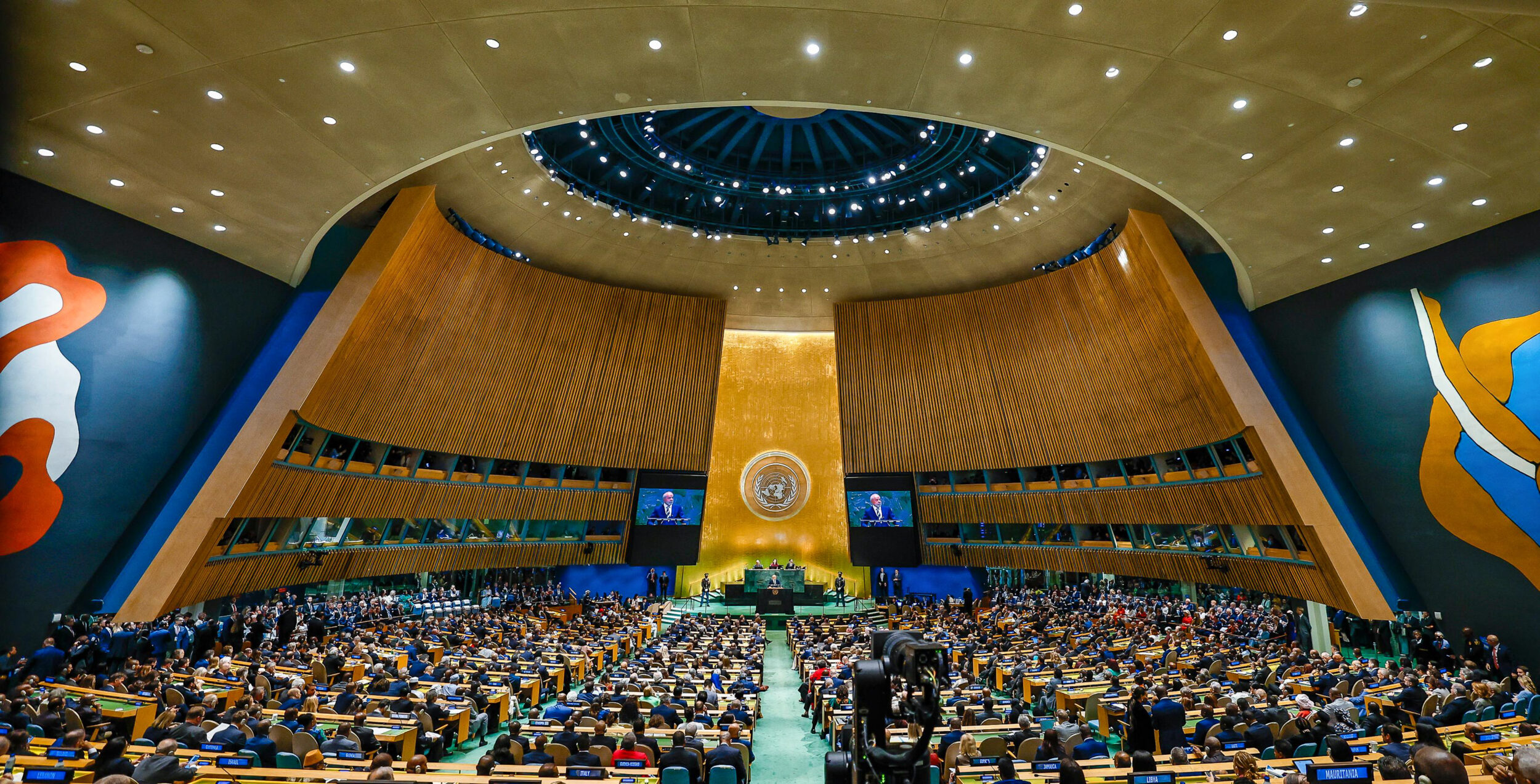
UNGA Pressure: An Insider’s Guide to Diplomacy’s Biggest Week
As the former Director of Speechwriting for the U.S. Ambassador to the United Nations, UNGA was my Super Bowl (right down to the halftime show). Come September, I’d watch sleepy Turtle Bay transform into a maze of barricades and motorcades, as delegations from nearly every country on Earth descended on six square blocks of Manhattan, running on little more than hope, lukewarm coffee, and snacks pilfered from the UN lunchroom (to those wondering, as I did, what they serve the world’s delegates: think less Epcot, more high school cafeteria—gossipy cliques included.)
And that’s just the official UN proceedings. By the time you count Climate Week, the hundreds of side summits and bilaterals, the CEO forums, the philanthropic convenings, the NGO panels, the networking happy hours, the off-the-records and on-the-records and for-the-records—you have one of the densest concentrations of global power, expertise, money, and ambition anywhere on Earth.
Yes, it’s absurd: a vestige of an era when getting every foreign minister in the same room required a fleet of puddle-jumpers, not a Zoom link. But I can also attest that, at its best, UNGA is a week where extraordinary things—unlikely partnerships, game-changing announcements, truly innovative initiatives—can happen. So, here’s how to make the most of it: whether you’ve scored a coveted blue badge, or are angling for a speaking slot twenty blocks downtown.
- Don’t just focus on the big stage
If your goal is getting seen—and that’s a legitimate goal!—then by all means, it’s worth the effort to secure a keynote on the big stage or a spot on a flagship panel. Leonardo DiCaprio’s 2014 UN address, and Greta Thunberg’s remarks at the 2019 Climate Action Summit, are still quoted to this day—proving that even in an age of direct-to-camera videos and flashy infographics, the dais still holds sway.
That said, if your goal is getting something done, you’re just as likely to move the needle in a hallway, at a bilateral meeting, or over lunch (I recommend John’s Coffee Shop on 44th and Second Ave). Reserve time for these more intimate moments—and know that a smaller room isn’t a consolation prize; more often than not, it’s the room where it happens.
- Offer many angles on one story.
It’s tempting, given so many disparate events, to treat each one as an island: to offer as many stories and soundbites as possible, each microphone an opportunity to share a fresh idea. There’s also the opposite temptation: to recycle the same turns of phrase at every single stop, regardless of audience, rather than start fresh each time.
The better strategy is somewhere in the middle. Every engagement should point toward one core takeaway, but each should illuminate it from a different angle. Before you load your calendar with three versions of the same climate luncheon, ask yourself: what opportunity does this event, and this event alone, provide? What’s the new data point, the fresh perspective, the previously unheard-from stakeholder that only this room can showcase?
- Practice your pitch (then practice it again).
You will introduce yourself more times in a single week than in the rest of your year combined, usually in a 1-minute window: in the badge-check line, waiting behind a barricade for a motorcade to pass, on a stalled escalator (is there a metaphor there?). You can’t plan the circumstances, but you can plan your talking points: who you are, what you do, and why it matters.
And bring actual, physical business cards. You will not find an empty outlet within a mile of the UN, which means, if you’re anything like me, your phone will be more of a paperweight than a means of taking down contact information.
- Craft language others will borrow…
At best, your words have multiple lives: when they’re first spoken, and then when they’re repeated—by partners on panels, officials in interviews, and reporters in their write-ups. Those additional lives are especially critical in a media environment this crowded; coverage is always something of a lottery, but the more times your words appear, the more tickets you’ve bought.
That said, achieving that pick-up is easier said than done. Your idea has to be interesting enough to catch on—but it also has to be simple enough to survive being lifted out of context, translated into another language, and articulated by someone who didn’t think of it and has seconds to remember it correctly.
When in doubt, ask yourself: have I heard this before? If the answer is no, close your laptop, take a walk, and come back an hour later to see if you can still repeat it back to yourself, confidently and succinctly, without looking. Better yet: try to explain it from memory to your spouse or friend and see how blankly they stare at you afterward.
- …and share announcements others will get excited about.
High-Level Week—that’s the official name for what most people call UNGA—gets criticized for exactly the same reasons the UN does: there’s a whole lot of talk, and not a whole lot of teeth. Vague solidarity—the kind of language that used to earn a respectful, if slightly skeptical nod—now gets mostly eyerolls.
Specifics are what actually resonate with UNGA audiences: concrete commitments, plans that other governments or partners can sign onto, dollars-and-cents numbers attached to ambitious deadlines. If you want your communications strategy to deliver, build it around an actual deliverable; a great line in service of nothing gets you just that.
- Think about the other 51 weeks of the year
You’d think the week after UNGA was a time for rest—for catching your breath, and catching up on everything you’ve neglected the past month. But the real test of your message’s staying power is whether it continues to live on, long after the last delegation has left Turtle Bay.
Re-engage the partners you met during the week before the relationship goes cold. Share takeaways with stakeholders back home who weren’t in the room, and are relying on you to paint a picture. And most importantly: match every commitment made in September with next steps carried out over the course of the year.
UNGA remains an anachronistic week, organized by a beleaguered institution, in a city that mostly resents hosting it. And still, I find myself moved by it: by the fact that, in a moment of profound cynicism about whether diplomacy works, thousands of people with very little in common continue to show up and attempt it. That dignitaries and CEOs, activists, scientists, and philanthropists who might otherwise never share a room end up in the same security lines and breakfast buffets—offering innumerable chances to argue about (or even better, come to agreement on) how to lift people out of poverty, eradicate disease, prevent wars, and keep the planet livable for the next generation.
That for every too-long speech and empty declaration, there is a story that makes people think differently about an issue; an encounter that spurs new and transformative partnerships; an idea that really does change the world.
It’s a strange, sprawling, silly week—and one that matters now more than ever. So—bring on the chaos, the caffeine, and the late-night rewrites…and let the fun(GA) begin.
West Wing Writers has supported delegations, foundations, NGOs, and leaders of every stripe in making their message heard—in Turtle Bay, in the press, and in the months following UNGA. If you’re heading to New York this September and want help making the most of your experience, get in touch.